How Many Concrete Blocks Do I Need? A Contractor's Guide
A practical estimating guide with real worked examples, from measuring your wall to calculating block count, accounting for waste, and placing a smart material order.
Quick Answer: For a standard 8×8×16 CMU wall, multiply your wall area in square feet by 1.125 to get your base block count, then add 10% for waste. A 20×8 ft wall needs about 198 blocks with waste included. Use the concrete block calculator to get an exact count in 30 seconds.
How Many Concrete Blocks Do I Need?
Figuring out how many concrete blocks you need before ordering is the difference between a smooth job and a half-finished wall waiting on a delayed delivery. Get the count right the first time and you'll avoid the two most common ordering mistakes: coming up short mid-job or paying to haul back excess material.
This guide walks through the full estimating process, measuring walls, choosing the right block size, running the calculation by hand, and applying a realistic waste factor.
Measure Your Wall Correctly
Before any math, you need two numbers: wall length and wall height, both in feet (or both in inches, just be consistent throughout).
Measure the total linear feet of wall you're building. If you have corners, measure each section separately and add them together. Don't forget to subtract for any door or window openings, those areas don't get filled with block.
For height, know your finished wall height and remember that block courses don't always land perfectly on your target. Standard 8×8×16 CMU with a 3/8" mortar joint comes out to exactly 8 inches per course. A 4-foot wall is 6 courses, an 8-foot wall is 12 courses, a 10-foot wall is 15 courses. If your target height doesn't divide evenly by 8 inches, you'll need to plan for a cut course or adjust your design.
Account for Openings
For a window or door opening, calculate the opening area in square feet and subtract it from your total wall area before running the block count. A standard 3-foot door opening in an 8-foot wall removes 24 square feet from the calculation, that's roughly 27 blocks at standard spacing.
For more complex openings like arched entries or grouped windows, break each opening into its approximate rectangle and subtract. You'll err slightly on the side of over-ordering, which is the right direction.
Understand Standard Block Dimensions
The most common block in North America is the 8×8×16 CMU, that's the nominal dimension. The actual block measures 7-5/8" × 7-5/8" × 15-5/8", with the difference made up by the 3/8-inch mortar joint on each face.
Because the mortar joint is built into the nominal dimension, the math stays clean when you use nominal sizing throughout.
The standard rule of thumb: 1.125 blocks per square foot of wall area (based on 8×8×16 CMU in running bond with 3/8" joints).
If you're using 6×8×16 or 4×8×16 blocks, the height per course doesn't change (still 8" with mortar), and the face coverage stays at 16" wide. The wall thickness is the only thing that changes. See our post on CMU types and nominal dimensions for the full breakdown.
The Block Calculation Formula
Here's the formula, step by step:
Step 1: Calculate gross wall area:
Wall Length (ft) × Wall Height (ft) = Gross Area (sq ft)
Step 2: Subtract openings:
Gross Area − Opening Area (sq ft) = Net Wall Area
Step 3: Multiply by block factor:
Net Wall Area × 1.125 = Blocks Needed (before waste)
Step 4: Add waste factor:
Blocks Needed × 1.05 to 1.10 = Final Order Quantity
The 1.125 factor is based on 112.5 standard blocks per 100 sq ft, the industry-standard coverage for 8×8×16 CMU in running bond. It holds consistent whether you're building a 10-foot wall or a 400-foot wall.
Worked Example: 40ft × 8ft Wall
Let's run the numbers on a 40-foot long, 8-foot tall wall, a common size for a backyard privacy wall or a small commercial screen wall.
Gross area: 40 ft × 8 ft = 320 sq ft
No openings in this example.
Block count before waste: 320 × 1.125 = 360 blocks
Add 10% waste: 360 × 1.10 = 396 blocks
Round up to the nearest pallet. Most suppliers sell in pallets of 72 or 90 blocks depending on size. 396 blocks rounds up to 5 pallets of 90 (450 blocks) or 6 pallets of 72 (432 blocks).
So a 40ft × 8ft wall needs approximately 440 blocks when rounded to a full pallet with waste included. The slight overage gives you material for cuts and the occasional cracked block.
You can skip the manual math and get this result instantly with the concrete block calculator, just enter your wall dimensions and it handles the formula and waste factor automatically.
Block Count by Course: An Alternative Method
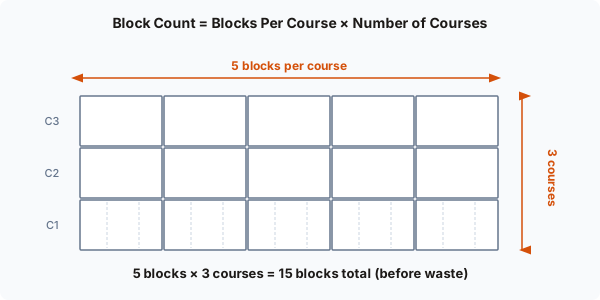
Another approach is course-by-course counting, which is useful when you're building to a specific height and want to verify your math from a different angle.
Blocks per course: Wall Length (inches) ÷ 16
For a 40-foot wall: 480 in ÷ 16 = 30 blocks per course
Number of courses: Wall Height (inches) ÷ 8
For an 8-foot wall: 96 in ÷ 8 = 12 courses
Total blocks: 30 × 12 = 360 blocks, which matches the formula result above.
This method also makes it easy to spot cut situations. If your wall is 41 feet (492 inches), 492 ÷ 16 = 30.75, meaning each course needs 30 full blocks plus a 12-inch cut block. Over 12 courses, that's 12 custom cuts. Know this before delivery.
Waste Factor: What's Realistic?
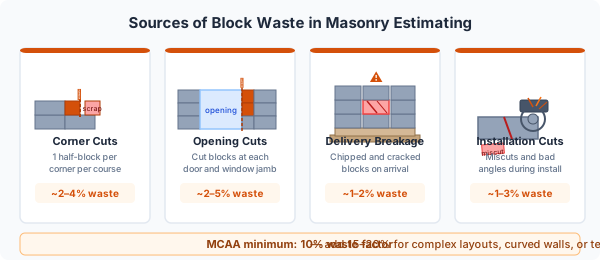
Waste in CMU work comes from blocks cracked during transport, cuts that don't go cleanly, corners that need closure blocks, and units damaged during handling. The right waste percentage depends on the job:
- Simple rectangular wall, no curves, experienced crew: 5%
- Wall with corners, offsets, or window openings: 8–10%
- Complex layout, curves, or first-time DIY: 10–15%
For most residential and light commercial work, 10% is the standard and gives you a reasonable buffer. Our post on masonry waste factors and how to apply them goes deeper on this, including what to do with leftover blocks rather than hauling them back.
Quick Reference: Block Counts for Common Wall Sizes
| Wall Size (ft) | Sq Ft | Blocks (no waste) | Blocks (10% waste) |
|---|---|---|---|
| 20 × 4 | 80 | 90 | 99 |
| 20 × 6 | 120 | 135 | 149 |
| 40 × 4 | 160 | 180 | 198 |
| 40 × 8 | 320 | 360 | 396 |
| 60 × 8 | 480 | 540 | 594 |
| 100 × 8 | 800 | 900 | 990 |
These are based on standard 8×8×16 CMU. For 6-inch or 12-inch blocks, face coverage stays the same, only the wall thickness changes.
Ordering Tips That Save Money
Order by the pallet, not the block. Loose blocks cost more per unit and are harder to count accurately. Full pallets come shrink-wrapped and strapped, which also reduces transport damage.
Check pallet quantities before ordering. They vary by supplier, some run 72 blocks per pallet, others 80 or 90. Ask before you calculate your pallet count.
Order one extra pallet if you're close. If your calculation lands at 4.7 pallets, order 5. Returning a partial pallet is usually possible; holding up construction waiting on a second delivery is expensive.
Specify the block type when you order. Standard hollow CMU, lightweight CMU, and solid cap blocks all look similar in descriptions but are different products. Confirm you're ordering 8×8×16 standard hollow if that's what your plans call for.
Ask about lead time. In busy construction seasons (spring and summer), block suppliers can be backed up 2–3 days on deliveries. Don't assume same-day availability.
Run Your Estimate Before You Call the Supplier
The block quantity estimator gives you an accurate count with waste factor built in, takes about 30 seconds. From there, check the concrete block cost guide to price out your material order before you call the supplier.
Knowing your numbers going into that call means you get better pricing and don't get sold material you don't need.
Ready to estimate your project?
Use our free calculator to get an accurate block count in 30 seconds.
Open CalculatorConcrete Block Calculator Team
The Concrete Block Calculator team builds free, accurate masonry estimating tools based on NCMA TEK Notes and industry-standard coursing arithmetic. Our content is verified against NCMA, ACI, and MCAA publications.
About us