Standard Concrete Block Sizes: Complete CMU Dimensions Guide
Concrete block sizes are standardized but not identical across all types. Here's the full guide to nominal vs. actual CMU dimensions, block types, weights, and which size to use for each application.
Quick Answer: Standard CMU blocks come in 4", 6", 8", 10", and 12" widths, all 8" tall and 16" long (nominal). Actual dimensions are 3/8" smaller in each direction to allow for the mortar joint. The 8×8×16 is the default for most structural and residential walls.
Standard Concrete Block Sizes
Concrete block sizes follow standard nominal dimensions, but the actual block is always 3/8 inch smaller on each face to leave room for the mortar joint. If you've ever ordered a "16-inch block" and wondered why it measures 15-5/8 inches in your hand, that's the reason. Understanding this difference, and when each size is the right choice, saves you from ordering the wrong product and finding out on delivery day.
This guide covers every common CMU size, the difference between nominal and actual dimensions, block weights, and which application each type is designed for.
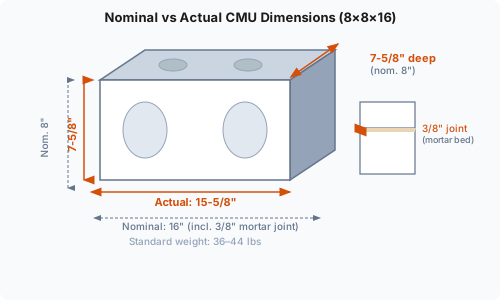
Nominal vs. Actual Dimensions: What the Numbers Mean
Every CMU is described by its nominal dimensions, height × width × length in inches. Nominal dimensions assume a 3/8-inch mortar joint on all faces.
The actual block is 3/8 inch smaller in each direction:
- Nominal 8" height → Actual 7-5/8"
- Nominal 8" width → Actual 7-5/8"
- Nominal 16" length → Actual 15-5/8"
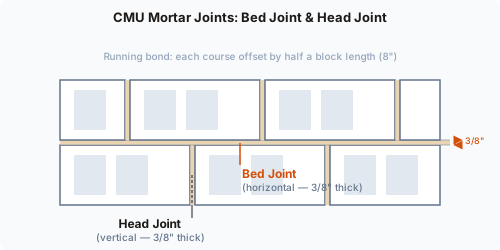
When you lay a 15-5/8" block with a 3/8" head joint, the combined distance is exactly 16", one nominal unit. This is why CMU layout math always uses nominal dimensions. The arithmetic comes out clean when you stick to nominal throughout.
A 40-foot wall is exactly 30 standard nominal-16" blocks. A 8-foot wall is exactly 12 standard nominal-8" courses. Nominal sizing was designed for this convenience.
Why It Matters for Estimating
If you measure existing block in the field and try to count how many fit in a given length using the actual dimension instead of nominal, you'll throw off your course count. Always use 16 inches as your horizontal unit and 8 inches as your vertical unit when estimating standard CMU, regardless of what the block measures in your hand.
The block count estimator handles this correctly. Just enter your wall dimensions in feet and it uses nominal sizing throughout.
Standard CMU Sizes by Type
8×8×16 CMU: Standard Block
This is the most common CMU in North America. It's used for structural walls, garden walls, commercial construction, and foundations. When someone says "concrete block" without qualification, this is almost certainly what they mean.
- Nominal: 8" H × 8" W × 16" L
- Actual: 7-5/8" × 7-5/8" × 15-5/8"
- Weight: 36–44 lbs (varies by aggregate; lightweight CMU runs 26–30 lbs)
- Best for: Load-bearing walls, exterior walls, above- and below-grade structural applications
The standard 8×8×16 comes in both normal weight (NW, ~38 lbs) and lightweight (LW, ~28 lbs) versions. Lightweight CMU uses expanded shale or clay aggregate to reduce weight. It's easier to handle and has better thermal performance, but costs 10–15% more. For walls over 8 feet, the labor savings from lighter blocks often offset the higher material cost.
4×8×16 CMU: Partition Block
The 4-inch block is a non-structural partition unit. It's used to divide interior spaces where the wall carries no load, think interior dividing walls in warehouses, mechanical rooms, and commercial bathrooms.
- Nominal: 4" H × 4" W × 16" L (note: height is still 8" per course with mortar; the 4" refers to thickness)
- Actual: 7-5/8" × 3-5/8" × 15-5/8"
- Weight: 18–24 lbs
- Best for: Non-structural interior partitions, infill panels, landscape edging
- Not for: Load-bearing, retaining walls, below-grade applications
The 4-inch partition block is significantly lighter than its full-size counterpart, which speeds up installation in non-structural applications.
6×8×16 CMU: Medium Block
The 6-inch block occupies the middle ground between partition and structural. It's popular for residential garden walls, medium-height landscape walls, and lightly loaded above-grade walls.
- Nominal: 6" H × 6" W × 16" L
- Actual: 7-5/8" × 5-5/8" × 15-5/8"
- Weight: 28–34 lbs
- Best for: Garden walls up to 4–5 feet, privacy screens, light commercial partition walls that need some lateral stability
For a residential garden wall under 4 feet tall with no surcharge, a 6-inch CMU is adequate and meaningfully cheaper than an 8-inch. Above 4 feet or where soil is retained, move up to 8-inch.
12×8×16 CMU: Heavy Duty Block
The 12-inch block is a serious structural unit. You'll find it in commercial retaining walls, taller foundation walls, and any application where lateral loads are high enough that 8-inch CMU, even fully grouted, doesn't have sufficient section depth.
- Nominal: 12" H × 12" W × 16" L
- Actual: 7-5/8" × 11-5/8" × 15-5/8"
- Weight: 70–85 lbs
- Best for: Retaining walls over 4 feet, commercial and industrial foundations, seismic applications requiring additional section depth
At 70–85 lbs each, 12-inch blocks are physically demanding to lay. Most commercial projects using 12-inch CMU have a second person (the tender) dedicated to moving and setting block so the mason can keep pace. Labor costs are noticeably higher per square foot.
8×4×16 CMU: Half-Height Block
This block is the same face length as the standard 8×8×16 but half the height. It's used to start a wall at a half-course, to cap walls, and to match into existing coursework where full blocks don't fit.
- Nominal: 4" H × 8" W × 16" L
- Actual: 3-5/8" × 7-5/8" × 15-5/8"
- Weight: 18–24 lbs
- Best for: Wall starters, caps, step-down courses, matching into existing blockwork
Complete Size Reference Table
| Block Type | Nominal (H×W×L) | Actual (H×W×L) | Approx. Weight | Best Application |
|---|---|---|---|---|
| Standard | 8×8×16 | 7-5/8×7-5/8×15-5/8 | 36–44 lbs | Structural and exterior walls |
| Lightweight Standard | 8×8×16 | 7-5/8×7-5/8×15-5/8 | 26–30 lbs | Same as standard, easier handling |
| Partition | 4×8×16 | 3-5/8×7-5/8×15-5/8 | 18–24 lbs | Non-structural interior partitions |
| Medium | 6×8×16 | 5-5/8×7-5/8×15-5/8 | 28–34 lbs | Garden walls, light exterior use |
| Heavy Duty | 12×8×16 | 11-5/8×7-5/8×15-5/8 | 70–85 lbs | Retaining walls, commercial foundations |
| Half-Height | 4×8×16 | 3-5/8×7-5/8×15-5/8 | 18–24 lbs | Caps, starters, closures |
Specialty Block Types
Bond Beam Block
Bond beam CMU has a channel cut through the webs, allowing a horizontal rebar to run the full length of a course. The course is then grouted solid. Bond beam courses are typically placed at the top of a wall, at door and window openings, and at specified intervals in walls over 8 feet tall.
Think of bond beam courses as horizontal beams built into the wall. They tie vertical cells together and significantly improve resistance to lateral loads. For any wall over 4 feet or near vehicle traffic, bond beam courses are worth specifying.
Lintel Blocks
Lintel blocks are U-shaped units designed to span door and window openings. They're placed with the open channel facing up, rebar is placed inside, and the channel is grouted to form a reinforced concrete beam. The nominal height matches standard CMU, so a lintel course fits flush into the wall without adjustment.
Split-Face CMU
The same structural block as the standard 8×8×16, but the face is split during manufacturing to create a rough, textured surface. Split-face CMU is purely aesthetic, used for exposed exterior walls in commercial and institutional construction where you want the structural system to also serve as the finished face.
Split-face costs roughly 20–40% more than standard block. It's also harder to cut cleanly (the split texture doesn't hold a saw cut edge as well), so waste factors run higher.
How Block Size Affects Your Material Count
The blocks-per-square-foot calculation doesn't change between 4-inch, 6-inch, 8-inch, and 12-inch CMU, they all use the same 16"×8" nominal face. So 1.125 blocks per square foot applies to all standard face-size CMU regardless of wall thickness.
What changes with block size: mortar volume, grout volume, and labor time. A 12-inch fully grouted wall uses significantly more mortar and grout per linear foot than a 6-inch garden wall. Factor that into your total material budget.
Use the CMU quantity calculator to get your block count for any standard size, it uses the correct nominal dimensions and lets you adjust the waste factor for your specific job conditions.
Ordering the Right Block
When you call your supplier, specify:
- Block size (nominal, e.g., "8×8×16")
- Block type (standard weight or lightweight)
- Whether you need specialty units (bond beam, half-block, etc.)
- Quantity in blocks or pallets
Don't assume the supplier knows what type you need from size alone. Standard, lightweight, and high-strength versions of the same nominal size all look identical in a catalog.
For estimating total block quantity with the right waste factor applied, our post on calculating your concrete block order walks through the full formula. And if you're matching mortar to block size, see the mortar for CMU guide for the correct mix type by application.
Ready to estimate your project?
Use our free calculator to get an accurate block count in 30 seconds.
Open CalculatorConcrete Block Calculator Team
The Concrete Block Calculator team builds free, accurate masonry estimating tools based on NCMA TEK Notes and industry-standard coursing arithmetic. Our content is verified against NCMA, ACI, and MCAA publications.
About us