How Much Mortar Do You Need for Concrete Block Work?
Mortar is the piece of the material estimate that most people get wrong. Here's how to calculate mortar quantities for CMU work, which mortar type to use, and how to mix it correctly.
Quick Answer: Plan on 1 bag (80 lb) of Type S masonry mortar mix per 100 standard 8×8×16 blocks. For outdoor and below-grade walls, always use Type S, not Type N. Add 10% extra to your mortar order to account for waste and wall ends.
Mortar for Concrete Blocks
Mortar for concrete blocks is one of the most under-estimated items on a masonry material list. It's common to calculate blocks carefully and then grab a few bags of mortar as an afterthought, which usually means a mid-job run to the supply yard. Getting the mortar quantity right upfront is straightforward once you know the rules of thumb and understand which mortar type your application actually requires.
This guide covers how much mortar you need, the different mortar types and when to use each, mixing ratios, and a worked example you can apply to your own project.
The Two Types of Mortar Joints in CMU Work
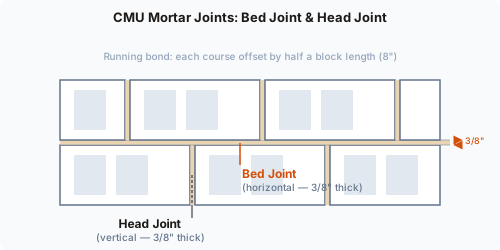
Before calculating quantity, you need to understand the two joints you're filling on every course:
Bed joints (horizontal) run along the top of each course. They receive the block above them. For standard CMU, a bed joint is 3/8 inch thick and spans the full length of the block on the outer shells, for hollow CMU, that's two strips of mortar (face shells only), not a solid bed across the full width.
Head joints (vertical) sit between the ends of adjacent blocks in the same course. They're also 3/8 inch thick. Properly buttering head joints is one of the most skipped steps in amateur block work, and it's one of the main reasons for water infiltration later.
Both joints consume mortar. The standard estimate accounts for both automatically.
How Much Mortar Per Block
The industry rule of thumb for standard 8×8×16 CMU in running bond:
1 bag (80 lb) of Type S masonry cement mix covers approximately 100 standard blocks
This works out to roughly 0.5 cubic feet of mortar per 100 blocks when mixed to proper consistency. The 80 lb bag typically yields about 0.6 cubic feet of mortar before set, which accounts for some waste and variation in joint thickness.
If you're using 60 lb bags (more common at home improvement stores), figure 1.33 bags per 100 blocks, so about 1 bag per 75 blocks.
For quick mental math:
- 100 blocks → 1 bag (80 lb)
- 200 blocks → 2 bags
- 500 blocks → 5 bags
- 1,000 blocks → 10 bags
These numbers assume standard face-shell bedding on hollow CMU. If you're fully bedding (solid mortar bed across the entire block width), add 30–40% to your mortar estimate.
Worked Example: 30ft × 6ft Privacy Wall
Here's a practical mortar estimate for a 30-foot long, 6-foot tall privacy wall in standard 8×8×16 CMU.
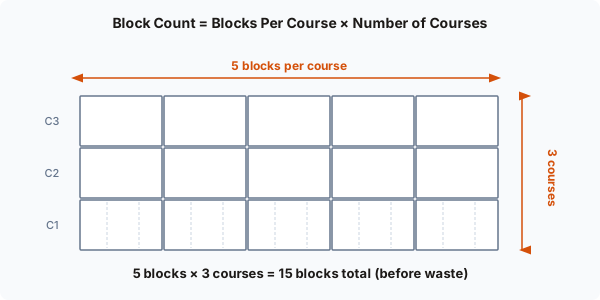
Step 1: Get the block count:
A 30 ft × 6 ft wall with no openings and 10% waste = approximately 228 blocks (see the concrete block calculator for an exact count).
For this example, we'll work with 228 blocks.
Step 2: Calculate mortar bags:
228 blocks ÷ 100 blocks per bag = 2.28 bags
Round up to 3 bags of 80 lb Type S masonry cement.
Step 3: Add a buffer:
For a wall with two exposed ends (which need full head joints on the returns), add 1 extra bag. Total: 4 bags.
That's a manageable quantity. At $18–$22 per 80 lb bag, mortar adds about $72–$88 to the material cost of this wall, a line item that's easy to forget but shouldn't be.
Mortar Types for CMU: Which One to Use
This is where many DIYers go wrong. There are four ASTM-specified masonry mortar types for CMU work, and they're not interchangeable.
Type S: The Standard for CMU Exterior Work
Compressive strength: 1,800 psi at 28 days
Type S is the workhorse mortar for CMU construction. It's specified for:
- All exterior above-grade walls
- Walls in contact with soil (below-grade)
- Any wall exposed to weather
- Retaining walls and foundation walls
Type S has a good bond strength and reasonable flexibility, it won't crack as readily as the higher-strength Type M when there's minor differential settlement.
For most residential and light commercial CMU work, Type S is the correct default.
Type N: Interior Non-Structural Use Only
Compressive strength: 750 psi at 28 days
Type N is a medium-strength mortar intended for interior non-structural masonry. It's softer and more workable than Type S, which makes it easier for less experienced masons to use. But its lower strength means it's not appropriate for exterior walls or any wall carrying significant load.
Use Type N only for:
- Interior non-load-bearing partitions
- Above-grade interior work in conditioned spaces
- Tuck-pointing repairs on interior masonry
Don't use Type N outside or below grade. It doesn't have the durability to handle freeze-thaw cycles or moisture exposure.
Type M: High Strength for Demanding Below-Grade Work
Compressive strength: 2,500 psi at 28 days
Type M is the highest-strength mortar in common use. Its high cement content makes it strong but brittle, it doesn't accommodate movement as well as Type S. Most masonry engineers specify Type S even for demanding below-grade applications because Type M's brittleness can cause joint cracking when there's any differential settlement.
Type M is specified for:
- Retaining walls under significant soil pressure
- Below-grade foundations in aggressive soil conditions (high sulfate content)
- Heavy-load bearing walls specified by a structural engineer
Unless your engineer specifically calls for it, Type S is usually the better choice even below grade.
Type O: Soft Interior Work
Compressive strength: 350 psi at 28 days
Type O is used for interior, above-grade non-load-bearing applications and for tuck-pointing soft historic brick where you don't want the mortar to be harder than the masonry units. It has no place in CMU construction.
Mortar Type Quick Reference
| Type | Compressive Strength | Use Case |
|---|---|---|
| Type M | 2,500 psi | Heavy below-grade, high-sulfate soil |
| Type S | 1,800 psi | Standard exterior CMU, below-grade walls |
| Type N | 750 psi | Interior non-structural partitions only |
| Type O | 350 psi | Historic repair, soft interior masonry |
Mixing Ratios: Pre-Mixed vs. Site-Batched
Pre-mixed masonry cement (the bag labeled "Type S Masonry Cement") is the most practical option for jobs under 500 blocks. The cement and lime are pre-proportioned; you just add clean sand and water. Standard mix ratio is:
1 part masonry cement : 2.5–3 parts clean masonry sand (by volume)
This yields a workable mortar at a water-to-cement ratio of approximately 0.50–0.55. The mortar should hold its shape when squeezed in your hand but not crumble, if it crumbles, add a small amount of water; if it slumps, add sand.
Site-batched mortar from Portland cement + lime + sand is used on larger jobs where material cost optimization matters more than convenience:
- Type S: 1 part Portland cement + 0.5 parts lime + 4.5 parts sand
- Type N: 1 part Portland cement + 1 part lime + 6 parts sand
- Type M: 1 part Portland cement + 0.25 parts lime + 3.75 parts sand
Site-batching takes more care to get consistent proportions, but a bag of Portland cement costs significantly less than a bag of masonry cement on a per-volume basis. For a 500-block job the savings are minimal; for a 5,000-block job, they add up.
Mortar Life and Retempering
Mixed mortar has a usable life of about 2 hours at 70°F. In hot weather (above 90°F) or direct sun, that can drop to 60–90 minutes.
Retempering, adding water to stiffened mortar and remixing, is acceptable once, and only if the mortar is still within the 2-hour window. If you can't dent the mortar with your thumb, it's too stiff to retemper successfully and should be discarded. Retempering mortar that's partially set produces a weak joint.
This matters for estimating because you want to batch mortar in quantities you can use within the working life. For a two-person crew (one laying, one mixing), 1–1.5 bags per batch is usually the right rhythm.
Cold and Hot Weather Precautions
Below 40°F: Mortar won't hydrate properly and may freeze before it gains strength. Either heat your mixing water, use a mortar accelerator, or don't lay block. Freshly laid masonry must be protected from freezing for at least 24 hours.
Above 90°F: Mortar dries too fast, especially in direct sun or wind. Mist blocks lightly before laying (don't soak them), keep mortar covered between uses, and batch in smaller quantities. Evaporation retarders are available but most experienced masons just batch smaller and work faster.
Don't Forget Grout
If your wall requires filled cores (any structural wall, any below-grade wall, any wall with rebar), you'll need masonry grout in addition to mortar. Grout is a separate product, a fluid mixture of Portland cement, aggregate, and water that's poured into cores after the wall is up.
Standard coarse grout covers approximately 1.2 cubic feet per 100 blocks for a standard 8×8×16 CMU with all cores filled. That's a significant added cost and quantity. For lightly reinforced walls with every other core filled, cut that in half.
Pull Your Block Count First
Mortar quantity flows from your block count. Get your accurate block total first, use the wall block estimator, then apply the 1 bag per 100 blocks rule to get your mortar quantity.
Our guide to building a concrete block wall step by step has more detail on proper joint placement and timing. And for a complete material waste rundown that covers both block and mortar overages, see the masonry waste factor guide.
Ready to estimate your project?
Use our free calculator to get an accurate block count in 30 seconds.
Open CalculatorConcrete Block Calculator Team
The Concrete Block Calculator team builds free, accurate masonry estimating tools based on NCMA TEK Notes and industry-standard coursing arithmetic. Our content is verified against NCMA, ACI, and MCAA publications.
About us