How to Build a Concrete Block Wall: Step-by-Step Guide
A practical, trade-level walkthrough for building a concrete block wall, from layout and corner leads to tooling joints and common mistakes to avoid.
Quick Answer: Build corner leads first, check them for level and plumb, then fill in between using a mason's line as your guide for every course. Set joints at 3/8", butter both the bed and head joints, and tool them when the mortar reaches thumbprint firmness (usually 30–60 minutes after laying).
How to Build a Concrete Block Wall
Learning how to build a concrete block wall properly separates walls that stand for 50 years from walls that crack, lean, or fail in the first winter. The technique isn't complicated, but the sequence matters, and the habits you build on the first course carry through every course above it.
This guide covers everything from the tool list to the final joint tooling, including the mistakes that trip up first-time block layers.
Tools You'll Need Before You Start
Don't shortcut the tool list. Missing even one of these slows you down and produces worse results.
- Mason's trowel (10"–11" pointing trowel is the most versatile)
- 4-foot level and a torpedo level for tight spaces
- Mason's line and line blocks or pins, this is non-negotiable
- Rubber mallet for seating blocks without chipping
- Chalk line for layout on the footing
- Block splitter (rental, ~$60/day) or angle grinder with a diamond blade for cuts
- Margin trowel for cleaning up joints and buttering small surfaces
- Jointing tool (sled runner or V-jointer) for tooling finished joints
- Tape measure, framing square, and a story pole if you're doing multiple courses
For mortar, you'll need a paddle mixer or mortar mixer for anything beyond a small repair job. Mixing by hand with a hoe is fine for a bag or two, not for a 200-block wall.
Step 1: Lay Out the Footing and Snap Your Lines
Your footing needs to be in place and cured before you lay a single block. Most residential footings need to cure at least 24–48 hours; anything structural should be at least 7 days old.
Snap chalk lines on the footing to mark the face of your wall on both sides. This gives you the exact wall position and helps you keep the first course straight regardless of any minor footing irregularities.
Do a dry run, lay a course of blocks without mortar along the chalk line from one end to the other. This tells you immediately whether you'll need cut blocks to close the run, and where those cuts will fall. Adjust your layout now, not after you've set 20 blocks in mortar.
Step 2: Set the Corner Leads First
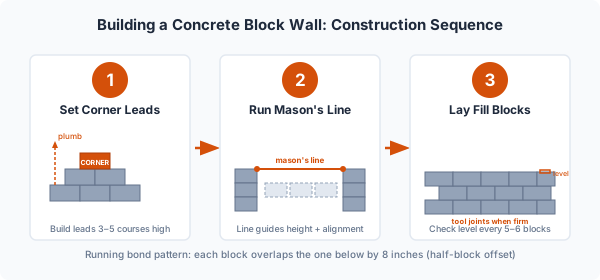
This is the most important skill in block laying. The corners, called leads, are built up 3–5 courses high before you fill in the middle. Every block between two corners will be guided by a string line stretched between those leads, so if your leads are level, plumb, and true, your wall will be too.
How to Build a Corner Lead
Set your first corner block in a full bed of mortar. Press it down firmly, check it for level in both directions, and check the face alignment against your chalk line. This block sets the height for the entire first course, don't rush it.
Add blocks out from the corner in both directions, stepping down one block each time. Course 1 might be 3 blocks long in each direction; course 2 would be 2 blocks in each direction from the corner; course 3 would be 1 block in each direction. The result looks like a staircase.
Check plumb on the face and ends of every block as you go. A lead that's 1/8" out of plumb at 3 courses becomes 1/2" out at 12 courses.
Running Bond vs. Stack Bond
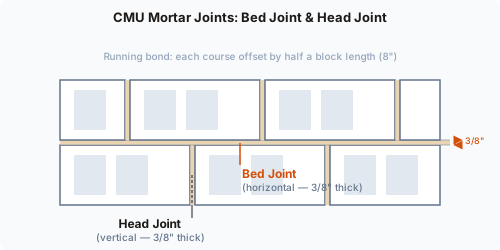
The standard pattern is running bond, each block overlaps the one below by half its length (8 inches for a 16-inch block). Running bond is structurally stronger because the joints don't stack vertically.
Stack bond, blocks stacked directly on top of each other with continuous vertical joints, is used mostly for aesthetic reasons and requires horizontal joint reinforcement (ladder wire) every other course to compensate for the reduced interlock. Don't use stack bond for retaining walls or any load-bearing application without an engineer's approval.
Step 3: Run the Mason's Line
Once both corner leads are up, stretch a mason's line between them at the top of the first course. The line should sit right at the top outside corner of the blocks, not touching the blocks but within 1/16 inch of the face.
Every fill block gets laid to that line. You're not using a level on every fill block (that would take forever); you're using the line for height and alignment, and spot-checking with a level every 4–6 blocks.
Skipping the mason's line is the single most common beginner mistake. Without it, courses wander up and down, and you end up either grinding high spots or shimming low spots with excess mortar. Neither fix looks good.
Step 4: Butter and Set Each Block
Bed joints (horizontal mortar) should be about 3/8 inch thick and applied to the top of the course already in place, not to the bottom of the block you're setting.
Head joints (vertical mortar) go on the ends of the block you're about to set. "Butter" both ears of the block with a generous glob of mortar, then press the block into position against the previous block so the head joint squeezes to about 3/8 inch.
Press the block down to the line height with your hands, then give it a firm tap with the rubber mallet. Check alignment against the string. Scrape off any mortar that squeezes out below the joint, don't let it harden on the face of the block.
A properly set block shouldn't need more than one or two taps to seat. If you're hammering hard, your mortar is probably too stiff or you're fighting the line height.
Step 5: Check Level Every Course
Even with a good string line, you should check the actual level of each course every 10–12 blocks. The line can sag slightly over long spans (use a line tensioner or a midpoint support block for runs over 20 feet).
Check plumb on corner blocks and any blocks at door or window openings. These are your control points, everything else fills in between them.
How to Cut Blocks
For a clean cut, score around all four sides of the block with the angle grinder before cutting through. This reduces chipping significantly. A block splitter (hydraulic or mechanical) is faster for straight cuts and produces a cleaner edge than an angle grinder on most standard CMU.
Never use a regular circular saw blade on concrete block. A diamond blade is the right tool; it costs $20–40 and lasts through hundreds of cuts.
Step 6: Tool the Joints
Once the mortar has reached "thumbprint hard", it holds a thumbprint but doesn't smear, it's time to tool the joints. This usually happens 30–60 minutes after placement depending on temperature and humidity.
Run your jointing tool along the horizontal joints first, then the vertical joints. Tooling compresses the mortar surface, which improves water resistance and gives the wall a finished look. A concave or V-profile are the two most common choices for CMU work.
Don't tool mortar that's still wet, it'll smear. Don't wait until it's fully hard, it'll crack under the tool. When in doubt, do a test stroke on an inconspicuous joint.
Worked Example: 20-Foot × 6-Foot Garden Wall
A 20-foot long, 6-foot tall garden wall using standard 8×8×16 CMU gives you roughly 112–120 blocks (counting a 10% waste factor, see our guide on masonry waste factors).
Use our concrete block estimating tool to get an exact count before you order.
For materials: figure approximately 0.3 bags of mortar per block, so roughly 34–36 bags of type S mortar mix (60 lb bags) for this wall.
Time estimates:
- Experienced mason: 6–8 hours including setup and cleanup
- Competent DIYer who's done this before: 1.5–2 days
- First-timer: Plan on 2–3 full days, and don't schedule anything critical the following weekend in case you need to come back
The time difference isn't just speed, it's also knowing when to stop and let mortar set up before resuming, reading the line without second-guessing it, and not over-handling blocks once they're placed.
Common Beginner Mistakes
Too much mortar in the bed joint. A 3/8-inch joint is the standard. Thicker joints take longer to cure and are more likely to crack. If you're constantly scraping off huge globs of squeeze-out, thin your bed joints.
Not checking plumb on the corners. You can fix a block that's 1/16" off plumb. You can't fix a wall that's 1" out of plumb at the top without tearing it down.
Skipping the mason's line for "just a few blocks." This is how wavy walls happen. Run the line every course, every time.
Wetting blocks in hot weather. In temperatures above 90°F or in direct sun, lightly dampen the blocks before laying. Dry blocks pull water out of the mortar too fast, which weakens the bond. Don't soak them, just a quick mist.
Laying more than you can tool in an hour. Especially in warm weather, mortar sets fast. Lay a manageable section, tool it, then continue. Don't get ahead of yourself.
Plan Your Block Count First
Before you mix a single bag of mortar, know exactly how many blocks you need. Showing up to the job site short by 30 blocks, after the wall's already halfway up, adds a half-day delay and a second delivery charge.
Run the numbers with our block wall calculator to get an accurate count with waste factor included. Then check out our posts on how many concrete blocks you need and mortar requirements for CMU walls to round out your material list before you start.
A well-planned job is a clean job. Get the estimate right, have everything on site, and the work goes smoothly.
Ready to estimate your project?
Use our free calculator to get an accurate block count in 30 seconds.
Open CalculatorConcrete Block Calculator Team
The Concrete Block Calculator team builds free, accurate masonry estimating tools based on NCMA TEK Notes and industry-standard coursing arithmetic. Our content is verified against NCMA, ACI, and MCAA publications.
About us