Why You Need a Waste Factor: Masonry Estimating Explained
Skipping the waste factor is how you end up 30 blocks short on a Friday afternoon. Here's what causes masonry waste, how much to add by wall type, and when the MCAA's 10% minimum isn't enough.
Quick Answer: The MCAA recommends a minimum 10% waste factor for standard rectangular CMU walls. Use 12–15% for walls with multiple corners or openings, and 15–25% for curved or diagonal-pattern walls. Apply the factor to your net block count after subtracting any openings.
The waste factor masonry estimators apply to their block counts isn't padding, it's accounting for real material that gets cut, chipped, broken, or doesn't make it off the truck intact. Get it wrong in either direction and the job suffers. Order too few and you're waiting on a second delivery. Order too many and you've tied up cash in blocks stacked behind the garage for two years.
This guide covers where waste actually comes from, what the industry standards recommend, and how to adjust those numbers for your specific project.
What Actually Causes Masonry Waste
Not all waste is equal. Some of it's predictable and you can calculate it precisely. Some is random and you just have to account for it statistically.
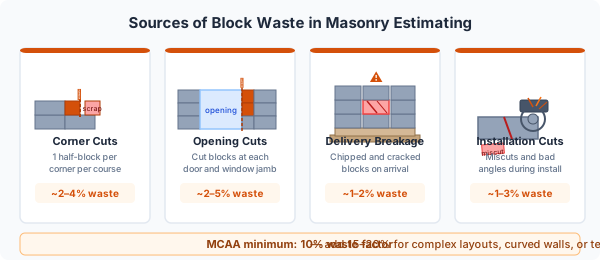
Corner Cuts
Every inside or outside corner in a running bond wall creates a cut block situation. The standard 8×8×16 CMU requires a half block (8 inches) at alternating courses to maintain the offset pattern. That's one half block per corner, per course, and if you have 12 courses and 4 corners, that's 48 half blocks.
Half blocks are available from most suppliers as a standard unit, so you can count these separately rather than pulling them from your field block supply. But cuts at non-90-degree corners, like angled retaining walls or curved garden walls, are full field cuts that generate scrap. Plan on one scrap piece per cut, and cuts at angles almost never give you a usable offcut.
Opening Cuts
Door and window openings need a cut block wherever the opening edge doesn't align with a block edge. In a typical 3-foot wide door opening with 16-inch blocks, you're cutting roughly 8 inches per jamb per course. For a 7-foot tall opening, that's 10–11 courses × 2 jambs = 20–22 cut blocks. Some of those cuts will be small enough to discard.
The block above the lintel is often a cut too, depending on how the opening height aligns with your course height. A 7-foot-tall opening in an 8-inch course wall is exactly 10.5 courses, which means the block sitting on the lintel needs to be split horizontally, which is a pain cut.
Delivery and Handling Breakage
Block manufacturers and suppliers generally quote 1–2% breakage on a standard delivery. That sounds small, but on a 500-block order, you're looking at 5–10 broken units arriving on the pallet. Corner chips are almost always present; full breaks are less common but happen in stacked shipments.
On-site handling adds more. Workers moving blocks from the stack to the wall, especially over rough ground or across scaffolding, chip and crack units at a rate that varies with crew experience. An experienced mason's laborer working efficiently might add 0.5% waste. An inexperienced one can add 2–3%.
Miscuts
This one stings the most because it's avoidable. A miscutted block, wrong length, cut at the wrong angle, split face cracked in the wrong place, is a total loss. On a job with lots of cuts (multiple openings, complicated layout), plan on 5–10% of your cut blocks going wrong. That might be 2–3% of total blocks on a standard job, or up to 8% on a complex decorative wall.
MCAA Standards: The Baseline Recommendations
The Masonry Contractors Association of America recommends a minimum 10% waste factor for standard rectangular CMU walls in running bond. This is the starting point, not the ceiling.
Their guidance breaks down roughly like this:
| Wall Type | Recommended Waste Factor |
|---|---|
| Simple rectangular wall, running bond | 10% |
| Wall with multiple corners or openings | 10–15% |
| Textured or split-face block | 12–15% |
| Complex layout, many openings | 15–20% |
| Curved walls | 20–25% |
| Diagonal or basketweave bond pattern | 15–20% |
These percentages are applied to your net block count after subtracting openings. If you've already subtracted the door and window areas from your wall area, you apply the waste factor to what's left.
When 10% Isn't Enough
The 10% minimum works for a simple, straight wall with no openings and experienced crew. In most real projects, something pushes that number higher.
Multiple Corners
Each additional corner is another cut sequence. A U-shaped wall with 4 inside corners and 4 outside corners generates significantly more corner cut waste than a straight run. For walls with more than 2 corners, bump to 12–15%.
Textured and Split-Face Block
Split-face CMU chips easily. The manufacturing process creates a textured face by splitting the block, which leaves microscopic fissures along the split face. Any subsequent cut or hard impact can propagate those fissures and ruin the face appearance. Add 2–3% over your standard waste estimate when using split-face block.
Multiple Small Openings
An electrical box penetration, a pipe sleeve, a small vent opening, each one requires a cut. Three small openings might add 8–12 individual cut blocks, each with significant scrap. On a wall with many small penetrations, add 2–3% just for those.
The Real Cost of Getting the Waste Factor Wrong
Ordering Too Few Blocks
Say you estimated 360 blocks and added only 3% waste (11 blocks), ordering 371. Your actual job runs to 383 blocks because of a corner you forgot to account for and some chipped units. You're 12 blocks short.
The cost isn't $30 in block material. It's:
- A second delivery charge: $100–$200
- Half-day delay while you wait for the delivery
- Crew downtime, a two-man masonry crew running $90–$130/hour sitting idle for 4 hours is $360–$520 in wasted labor
- Schedule ripple effects if you're on a multi-trade project
The 12 extra blocks you needed would have cost roughly $33–$48 at $2.75–$4.00 each. The shortfall cost you 10–15 times that.
Ordering Too Many Blocks
The opposite problem is real too, but less catastrophic. If you order 420 blocks and use 383, you've got 37 extras. At $2.75 each, that's $102 in unused material. If you can return unused full pallets (some suppliers allow this), you recover most of it. If not, those blocks stay on site.
Most experienced estimators accept a 5–8% overrun in materials on masonry jobs. The cost of the extra blocks is consistently lower than the cost of running short.
Waste Factors by Bond Pattern
The standard waste calculations assume running bond. Other patterns require different adjustments.
Running bond (standard): Baseline. Use MCAA recommendations as-is.
Stack bond: No offset between courses, so corner cuts are consistent rather than alternating. Waste from cuts is similar, but you need horizontal joint reinforcement every other course (ladder wire), which is an additional material cost. Stack bond waste is roughly equal to running bond waste.
Diagonal bond (45-degree pattern): Every block needs to be cut at 45 degrees at the wall edges. This is highly wasteful, you're cutting a triangle off every edge block. Expect 20–25% waste on diagonal layouts, not including the extra cutting labor.
Basketweave or herringbone: Requires precise cuts on a high proportion of blocks. These patterns are almost always decorative rather than structural. Waste of 15–20% is typical, more if the mason is inexperienced with the pattern.
Worked Example: Wall With Corners and an Opening
You're building an L-shaped garden wall: one leg is 24 ft long, the other is 16 ft long, both 5 ft tall. There's one 3 ft × 5 ft gate opening in the long leg.
Gross wall area:
- Long leg: 24 × 5 = 120 sq ft
- Short leg: 16 × 5 = 80 sq ft
- Total gross: 200 sq ft
Subtract opening: 3 × 5 = 15 sq ft → Net area: 185 sq ft
Base block count: 185 × 1.125 = 208 blocks
Waste factor: This wall has 1 outside corner (the L junction), 2 gate jamb cuts across 7 courses each (14 cut blocks), and is a DIY project with a less experienced installer. Use 15%.
208 × 1.15 = 239 blocks
You'd also order 14 half blocks separately for the corner alternating courses. Run those numbers yourself using the block quantity calculator to double-check before you call the supplier.
How to Apply the Waste Factor in Practice
- Calculate net wall area (gross area minus all openings)
- Multiply by 1.125 to get base block count for 8×8×16 CMU
- Identify the right waste percentage for your job type
- Multiply base count × (1 + waste fraction)
- Round up to the nearest full pallet when possible
The concrete block estimating calculator handles steps 1–5 automatically and lets you adjust the waste percentage for your job conditions. It's the fastest way to go from wall dimensions to an order-ready block count.
For a full breakdown of what those blocks will cost once you have your count, see the concrete block cost guide. And if you're unsure about your construction sequence, the CMU wall construction walkthrough covers the full laying process from footings to tooled joints.
Ready to estimate your project?
Use our free calculator to get an accurate block count in 30 seconds.
Open CalculatorConcrete Block Calculator Team
The Concrete Block Calculator team builds free, accurate masonry estimating tools based on NCMA TEK Notes and industry-standard coursing arithmetic. Our content is verified against NCMA, ACI, and MCAA publications.
About us