Concrete Block Cost in 2026: Full Price Breakdown
Concrete block cost varies significantly by block type, region, and whether you buy loose or by the pallet. Here are the actual numbers for 2026 with a full project cost example.
Quick Answer: Standard 8×8×16 CMU blocks cost $2.00–$4.00 each in 2026, depending on your region and order size. A 100 sq ft wall runs $225–$450 in block material alone. Pallet pricing beats loose block by 10–20%.
Concrete block cost depends on three things: the block type, where you're buying it, and how many you're ordering. A standard 8×8×16 CMU that runs $2.50 per block at a Southeast masonry supplier might cost $4.25 at a Northeast building materials outlet. Get the wrong number in your estimate and your material budget is off by hundreds before you drive the first stake.
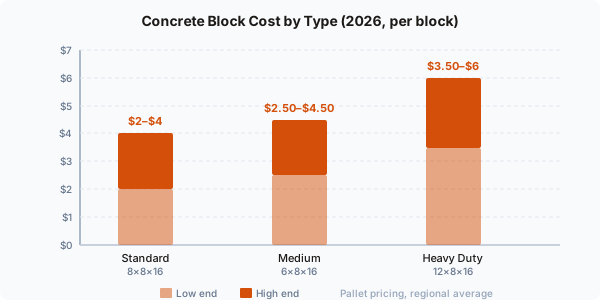
Block Type Price Ranges
These are current 2026 market prices based on supplier data across multiple regions. All prices are per block, purchased by the pallet.
Standard 8×8×16 CMU: $2.00 – $4.00 per block
This is the workhorse of masonry construction. It covers the majority of garden walls, structural walls, and commercial projects. At the low end of the range, you're buying from a regional masonry supplier in the Southeast or Midwest with volume pricing. At $4.00, you're looking at a metropolitan Northeast or West Coast supplier with smaller order quantities.
6×8×16 CMU: $2.50 – $4.50 per block
The 6-inch block is popular for residential garden walls, privacy fences, and non-load-bearing partitions. It's lighter than the 8-inch, typically 28 lbs vs. 38 lbs, which reduces labor cost on taller walls. Expect roughly a 15-20% premium over a comparable standard block.
12×8×16 CMU (Heavy Duty): $3.50 – $6.00 per block
These are used for retaining walls, commercial foundations, and any application requiring significant lateral load resistance. The weight (70-80 lbs per block) also means higher labor costs per sq ft. Price varies considerably based on aggregate availability in your region.
4×8×16 CMU (Partition Block): $1.75 – $3.25 per block
Used for non-structural interior partitions. Much lighter at around 18-22 lbs. Often purchased in smaller quantities because you're not running these through a full structural wall.
Specialty Blocks (Bond Beam, Lintel, Bullnose, Split Face):
- Bond beam CMU: $3.50 – $7.00 each
- Lintel blocks: $5.00 – $12.00 each (varies by span)
- Split-face CMU: $3.00 – $6.50 each
- Bullnose corner blocks: $4.00 – $8.00 each
If your project has exposed corners, decorative faces, or horizontal reinforcement courses, specialty units can easily represent 10-15% of total material cost.
Regional Price Variation
Masonry material prices track closely with two things: proximity to block manufacturers and local labor market conditions. Here's the general pattern:
| Region | Price Range (8×8×16 standard) | Notes |
|---|---|---|
| Southeast (GA, FL, SC, AL) | $2.00 – $2.75 | High manufacturer density, lower transport cost |
| Midwest (OH, IN, IL, MO) | $2.25 – $3.25 | Moderate supply, competitive market |
| Texas / Southwest | $2.50 – $3.50 | Wide variation; border markets often cheaper |
| Northeast (NY, NJ, CT, MA) | $3.00 – $4.00 | Higher logistics cost, union labor norms |
| West Coast (CA, OR, WA) | $3.25 – $4.50 | Seismic-rated blocks often required; higher baseline |
| Mountain West (CO, UT, AZ) | $2.75 – $4.00 | Varies significantly by metro vs. rural |
These are material-only prices. Delivery charges, fuel surcharges, and minimum order fees can add $75–$250 per delivery depending on distance and supplier.
Bulk vs. Loose Pricing
Buying by the pallet (cube) saves money, typically 8-15% vs. buying loose. A standard 8×8×16 block pallet holds 90 blocks. That means:
- 90-block pallet at $2.50/block = $225
- Loose at $2.90/block for same 90 blocks = $261
- Savings: $36 per pallet
On a 400-block job (roughly 4.5 pallets), that's $144 saved in material cost alone. Most suppliers will mix pallets if your count doesn't hit even numbers, ask specifically.
If you're ordering over 10 pallets, it's worth calling the manufacturer directly rather than buying through a retailer. Many regional CMU manufacturers sell direct with better pricing on larger projects.
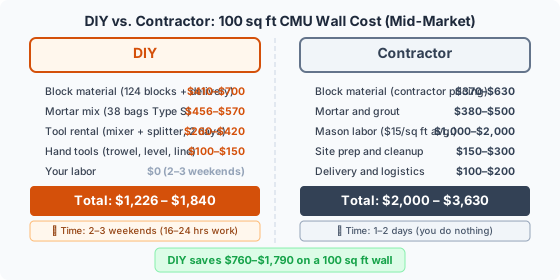
Labor Costs: What You'll Pay for Installation
Material is only part of the equation. Installed CMU wall costs break down like this in 2026:
DIY labor cost: $0 (your time), but factor in tool rental, a rented mixer runs $100–$150/day.
Union masonry labor: $45–$75/hr for a mason, plus a tender (laborer) at $28–$45/hr. Most unions require one tender per mason on commercial work.
Non-union residential contractor: $10–$20/sq ft installed is the typical range for a standard 8" running bond wall. That includes labor, mortar, and basic tool use, not block material.
All-in installed cost (material + labor):
- Standard 8" CMU wall, residential: $15–$28/sq ft
- 12" CMU retaining wall: $22–$40/sq ft
- Split-face CMU with color: $28–$50/sq ft
These numbers don't include rebar, grout fill, footings, or waterproofing. A fully engineered CMU retaining wall with all components can run $55–$80/sq ft installed.
Full Project Cost Example: 40 ft × 8 ft Wall
Let's price out a straightforward 40 ft long, 8 ft tall standard CMU wall in running bond, no openings.
Block count:
- Wall area: 40 × 8 = 320 sq ft
- Blocks at 1.125/sq ft: 360 blocks
- Add 5% waste: 18 blocks
- Order: 378 blocks (round to 4.5 pallets = 405)
Use the block quantity estimator to verify your count before pricing, catching an error here saves money.
Material cost breakdown (Midwest pricing):
| Item | Qty | Unit Cost | Total |
|---|---|---|---|
| Standard 8×8×16 CMU | 405 blocks (4.5 pallets) | $2.75/block | $1,114 |
| Type S mortar mix (80 lb bags) | 4 bags | $18/bag | $72 |
| Rebar #4 (if filling cores) | varies | ~$1.25/linear ft | varies |
| Delivery | 1 load | $125 flat | $125 |
| Material total | ~$1,311 |
Labor cost (non-union residential):
320 sq ft × $14/sq ft (mid-range) = $4,480
Estimated total project cost: $5,800 – $6,500 (Midwest, standard spec)
In a high-cost metro, the same wall can run $8,500–$11,000 installed.
Where to Buy Concrete Blocks
Masonry supply yards are almost always cheaper than big-box retail for standard block. Home Depot and Lowe's carry 8×8×16 CMU at $2.50–$3.50 per block loose, which is fine for picking up a few extras, but you'll pay 20-40% more than wholesale pricing on a full pallet.
Regional CMU manufacturers (Oldcastle, CEMEX, Quikrete, local independents) often have direct sales desks. Search "[your city] CMU manufacturer" or "[your city] masonry supply."
Online ordering through BuilderSource, Menards (Midwest), or regional distributors is growing, but delivery logistics for heavy block make it less practical than local pickup in most markets.
Once you've nailed down your pricing, calculate the exact number of blocks you'll need first. The concrete block estimating tool gives you a precise count by wall dimensions and block size, no manual math required.
For a closer look at mortar costs (which are often underestimated), see how much mortar you need for concrete block work. And if you're deciding between doing this yourself or hiring a contractor, the DIY vs. contractor masonry breakdown lays out the tradeoffs clearly.
Ready to estimate your project?
Use our free calculator to get an accurate block count in 30 seconds.
Open CalculatorConcrete Block Calculator Team
The Concrete Block Calculator team builds free, accurate masonry estimating tools based on NCMA TEK Notes and industry-standard coursing arithmetic. Our content is verified against NCMA, ACI, and MCAA publications.
About us