DIY Masonry vs Hiring a Contractor: Real Cost Comparison
DIY masonry vs contractor isn't a simple question of skill, it's a question of what the wall is doing, how tall it is, and what the actual cost difference looks like after tools and time. Here's an honest breakdown.
Quick Answer: DIY masonry saves $1,150–$2,150 on a 100 sq ft wall compared to hiring a contractor, but takes 2–3 weekends of physical work. Low garden walls under 3 feet are reasonable DIY projects. Retaining walls, load-bearing walls, and anything over 6 feet should be hired out.
DIY masonry vs contractor is one of those decisions where the right answer depends heavily on what you're building, not just whether you can swing a trowel. A 2-foot garden wall around a raised bed is a perfectly reasonable DIY project. A 5-foot retaining wall behind your house is not, regardless of YouTube confidence.
This guide gives you the actual cost numbers, the honest skill assessment, and a framework for deciding which category your project falls into.
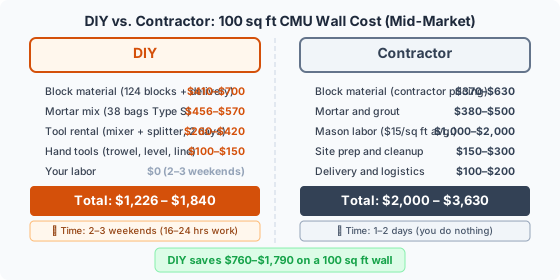
The Real Cost of DIY Concrete Block Work
DIY masonry looks cheap until you account for tools. Most homeowners don't own a block splitter, a mortar mixer, a 4-foot level, mason's line, or any of the other gear a mason shows up with. You're renting or buying all of it.
Tool Costs for a DIY Masonry Project
| Tool | Purchase | Rental (per day) |
|---|---|---|
| Mortar mixer (electric) | $350–$700 | $80–$130 |
| Block splitter | $300–$800 (hydraulic) | $50–$80 |
| 4-foot level | $40–$80 | n/a |
| Mason's trowel set | $40–$80 | n/a |
| Rubber mallet | $15–$30 | n/a |
| Chalk line and pins | $20–$35 | n/a |
| Mason's line and blocks | $10–$25 | n/a |
| Angle grinder (with diamond blade) | $60–$120 | $30–$50 |
For a one-time project, you're probably renting the mixer and block splitter and buying the hand tools. Two-day rental of a mixer and block splitter: $200–$400. Basic hand tools: $100–$150. Total tool outlay for a typical DIY masonry project: $300–$550.
That's before a single block goes down.
Material Cost: Same Whether You DIY or Hire
Block, mortar, and gravel cost the same regardless of who installs them. The only difference is that contractors often have trade accounts at masonry suppliers and pay 10–20% less per block than walk-in retail. Some let that savings pass to the client; others don't.
Estimate your block count first. Use the concrete block calculator to get an accurate material takeoff, you need this number whether you're DIYing or getting contractor quotes.
For a 100 sq ft wall (roughly 20 ft × 5 ft), material costs look like this:
| Material | Quantity | Estimated Cost |
|---|---|---|
| 8×8×16 CMU (with 10% waste) | 124 blocks | $310–$500 |
| Type S mortar mix (60 lb bags) | 38 bags | $456–$570 |
| Delivery | 1 load | $100–$200 |
| Material total | $866–$1,270 |
What Contractors Charge for CMU Work
Masonry labor pricing is quoted per square foot of installed wall or per day with a material-separate bid. Here's what you'll see in 2026:
Standard 8" CMU wall, running bond (labor only): $10–$20/sq ft
All-in installed price (material + labor + basic site cleanup): $20–$35/sq ft for standard work
Specialty work, split-face, textured block, complex layout: $35–$55/sq ft installed
Union commercial masonry: $45–$75/hr for a journeyman mason, plus a tender at $28–$45/hr
For our 100 sq ft wall:
- Labor at $15/sq ft = $1,500
- Material at ~$1,000
- Contractor total: $2,500–$3,500
Regional Variation
These numbers shift by region. In the Southeast, non-union residential masonry labor runs $8–$14/sq ft. In the Northeast or on the West Coast, $18–$25/sq ft is normal for residential. Get three quotes before deciding either way.
The Break-Even Analysis
For a 100 sq ft wall in a mid-cost market:
DIY total:
- Materials: $1,000
- Tool rental: $350
- Your time: 2–3 weekends (16–24 hours of actual work)
- Out-of-pocket: ~$1,350
Contractor total: $2,500–$3,500
DIY saves you $1,150–$2,150 on a 100 sq ft wall. That's meaningful money. But it takes 2–3 weekends of physical work, and the quality depends entirely on your execution.
For a 300 sq ft wall, the savings grow: DIY might run $3,000 in materials and tools vs. $7,000–$10,000 installed. At that scale, the time commitment is 6–10 weekends or more. Whether that trade is worth it is a personal decision.
The break-even point where contractor pricing starts to look more reasonable for most homeowners is around 400–500 sq ft, where the complexity, time commitment, and quality risk of DIY start to outweigh the cost savings.
What Skills Does DIY Masonry Actually Require?
Mixing Mortar Correctly
Mortar consistency is the first thing that goes wrong for DIYers. Too wet and it runs; too dry and it doesn't bond. Type S mortar (the correct choice for outdoor masonry) should hold its shape when scooped but spread smoothly off a trowel, something like thick peanut butter.
Follow the bag instructions by weight, not by eyeball. And mix in smaller batches than you think you need, mortar has a working life of about 1–2 hours before it starts to set up. Throwing away half-set mortar is frustrating and wasteful.
Reading a Level
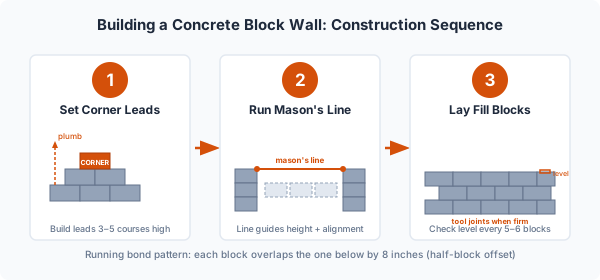
You need to check level, plumb (vertical alignment), and the string line constantly. Every 5–6 blocks, put the level on the face of the wall. Every corner block, check plumb on two sides. Every new course, verify your string line isn't sagging (it will over long spans, support it with a block in the middle).
Getting proficient at this takes time. On your first project, plan to check more often than seems necessary. An experienced mason does this instinctively; you'll have to do it deliberately.
Cutting Blocks
This is the hardest skill in CMU work. A clean cut on an 8×8×16 block without chipping the face takes practice. The technique:
- Score all four sides with an angle grinder and diamond blade before cutting through
- Cut along the score lines, don't try to cut all the way through in one pass
- For decorative face blocks, use a block splitter for a cleaner face
Budget extra blocks for cut practice. Your first 3–5 cuts will probably not look great, that's normal. Don't use those blocks in prominent visible locations.
What to Always Hire Out
Some masonry work should never be DIY, regardless of your skill level or cost savings.
Load-Bearing Walls
Any wall that carries a structural load from above, beam pockets, floor systems, roof loads, requires an engineer's design and an experienced mason to execute it. The consequences of failure are serious. This isn't a money conversation.
Retaining Walls Over 3 Feet
A retaining wall over 3 feet tall is holding back significant soil weight. The design requires knowledge of soil pressure, footing sizing, rebar placement, and drainage, things that aren't in YouTube tutorials. The NCMA recommends engineering for any retaining wall over 4 feet, and practical experience suggests starting that conversation at 3 feet.
See the retaining wall block estimating guide for a full breakdown of what goes into a properly designed retaining wall.
Foundation Work
CMU foundations involve code compliance, waterproofing, drainage, rebar, anchor bolts, and integration with the floor system. This is not DIY territory. The savings aren't worth the risk, and most jurisdictions require permits and inspections that will flag unlicensed foundation work.
Anything Over 6 Feet Tall
Higher walls require scaffolding, which adds safety risk and complexity. They also require more precise plumb and level control, because errors at the base are amplified at height. If you're building a wall over 6 feet, the competency gap between a homeowner and a professional mason is significant enough that the quality difference is visible.
The Rule of Thumb That Actually Works
Here's a simple framework:
DIY is reasonable if:
- The wall is decorative or functional (garden bed, low privacy screen, landscape border)
- It's under 3 feet tall
- It's not retaining soil
- It's not load-bearing
- You have 2–4 weekends available and can handle physical work
- The cost savings are meaningful to you
Hire a contractor if:
- It's a retaining wall over 3 feet
- It's load-bearing
- It's foundation work
- It's over 6 feet tall
- You need it done in days, not weekends
- Quality consistency matters (finished walls in a visible location)
The honest answer for most homeowners: low garden walls and simple landscape projects are good DIY candidates. Anything structural is not.
Getting Your Estimate Right Before Deciding
Whether you DIY or hire out, you need an accurate block count before you can make a real cost comparison. A contractor quote that doesn't specify materials is impossible to evaluate, you don't know if they're using 100 blocks or 200.
Run your wall dimensions through the CMU estimating calculator first. Get the block count and material quantities locked in. Then you can compare your DIY material cost against contractor all-in quotes on an apples-to-apples basis.
For the full rundown on what masonry materials cost, see the concrete block cost guide, it covers block pricing by type and region. If you're leaning toward DIY, the concrete block wall construction guide walks through the full step-by-step process so you know what you're getting into before you start.
Ready to estimate your project?
Use our free calculator to get an accurate block count in 30 seconds.
Open CalculatorConcrete Block Calculator Team
The Concrete Block Calculator team builds free, accurate masonry estimating tools based on NCMA TEK Notes and industry-standard coursing arithmetic. Our content is verified against NCMA, ACI, and MCAA publications.
About us