Retaining Wall Block Estimating: What You Need to Know
Estimating concrete blocks for a retaining wall isn't the same as estimating a garden partition. Batter, rebar, grout fill, and drainage all affect your material list. Here's how to get the count right.
Quick Answer: For a basic CMU retaining wall, multiply face area (length × exposed height) by 1.125 blocks per sq ft, then add 10% waste. Walls over 2 feet tall also need vertical rebar and grout fill in the cores, which is a separate material calculation. Anything over 4 feet requires an engineer.
Retaining wall block estimating has a few wrinkles that standard wall estimating doesn't. The wall leans. It needs rebar. The cores get grouted. And if you get the block size or the reinforcing wrong, you're not looking at a cosmetic problem, you're looking at a wall that moves or fails under soil pressure.
This guide covers how to estimate CMU retaining walls correctly, from choosing the right block size to calculating grout fill and rebar quantities.
How Retaining Walls Differ From Standard CMU Walls
A garden partition or privacy wall carries essentially no lateral load. You're fighting gravity and wind, both of which act relatively uniformly. A retaining wall is holding back saturated soil, which can exert 30–60 lbs per square foot of pressure at depth depending on soil type and drainage conditions.
That pressure changes two things about your estimate:
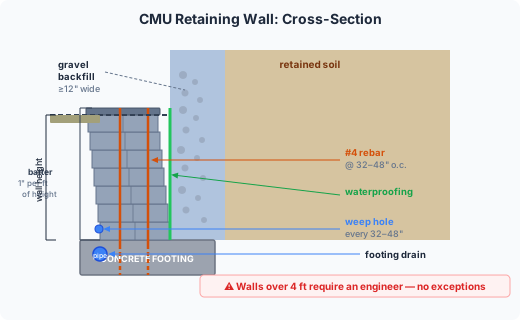
The wall leans back (batter). Most CMU retaining walls are built with a slight backward lean, called the batter, of about 1 inch per foot of wall height. A 4-foot retaining wall would lean back 4 inches at the top. This increases structural stability by moving the center of gravity back toward the fill.
This batter affects your face area calculation slightly. The face you're measuring for block count is the front face, the exposed side, which is the same height as your target retention height. You're not adding extra blocks for the batter; the batter is achieved by setting each course slightly back (roughly 1/4" setback per course on a 4-foot wall).
The cores need to be filled and reinforced. For any wall over 2 feet tall, you'll need vertical rebar and grout fill in the cores. That's a separate material estimate from the block count itself, and many estimators forget to include it.
Block Size Recommendations by Wall Height
The National Concrete Masonry Association (NCMA) publishes guidelines on CMU sizing for retaining walls. Here's the practical summary:
| Wall Height | Recommended Block | Notes |
|---|---|---|
| Up to 2 ft | 8×8×16 CMU | Minimal reinforcing if any |
| 2–3 ft | 8×8×16 CMU | Vertical rebar @ 48" o.c. recommended |
| 3–4 ft | 8×8×16 or 12×8×16 | Vertical rebar @ 32–40" o.c., grout fill |
| 4–6 ft | 12×8×16 CMU | Vertical rebar @ 24–32" o.c., full grout fill, engineering advised |
| Over 6 ft | Engineered design required | Cannot estimate without structural drawings |
The 12-inch block is heavier (70–80 lbs each vs. 38 lbs for 8-inch) and about $1.00–$2.00 more per unit, but it provides a thicker core for rebar and grout, and significantly more wall weight to resist overturning.
Don't use 6-inch or 4-inch CMU for retaining walls. They don't have the mass or the core depth for adequate reinforcement.
Calculating Block Count for a Retaining Wall
The base calculation is the same as any CMU wall: measure the face area, multiply by 1.125 (blocks per sq ft for 8×8×16), and add your waste factor.
The difference is the face area measurement. Use the exposed wall height, not the total height including the buried footing course. If you're building a 4-foot exposed retaining wall and setting the first course 6 inches into grade, the face height for your block count is still 4 feet.
Worked example: 40-foot × 4-foot retaining wall, 8×8×16 CMU
Face area: 40 × 4 = 160 sq ft
Base blocks: 160 × 1.125 = 180 blocks
Add 10% waste (simple wall, few cuts): 180 × 1.10 = 198 blocks (order 200)
Use the block count calculator to verify this number and adjust for different block sizes. At $3.00/block, you're looking at about $600 in block material before rebar and grout.
Account for the Footing Course
The first course of block is typically set in a full mortar bed on top of the footing, partially below grade. Add one additional course to your block count to account for this buried course. For the 40-foot wall example: 40 ft ÷ 1.33 ft per block = 30 blocks for one footing course. Add those to your order.
Rebar and Grout Fill: What You'll Need
This is where retaining wall estimates get longer than standard wall estimates. Every reinforced core needs both a rebar bar and grout to fill the space around it.
Rebar Spacing and Length
For a 4-foot retaining wall (standard 8×8×16), the typical spec is #4 rebar (1/2" diameter) at 32 inches on center. For a 40-foot wall, that's:
40 ft × 12 in/ft ÷ 32 in = 15 rebar bars
Each bar runs from the footing to within a few inches of the top of the wall. Your footing typically has a dowel stub projecting up 12–18 inches, with the vertical bar lapped onto that. For a 4-foot wall with a 12-inch footing depth, figure bars about 5.5 feet long (4 ft wall + 1 ft into footing + some overlap).
15 bars × 5.5 ft = 82.5 linear feet of #4 rebar
At roughly $0.60–$0.90 per linear foot for #4, that's $49–$74 in rebar for this wall.
Grout Fill Volume
Cores in a standard 8×8×16 CMU are roughly 3.4" × 5" on the inside dimensions (exact dimensions vary by manufacturer). For filled cores at 32" o.c., you're filling every other core in each course, roughly 50% core fill.
A common rule of thumb: a standard 8-inch block wall at 50% core fill uses about 4–5 bags of grout mix (80 lb bags) per 100 sq ft of wall. For 160 sq ft:
160 ÷ 100 × 4.5 bags = 7–8 bags of grout mix (order 10 for safety)
For a 12-inch block with full core fill, that number doubles. At full grout fill in 12" CMU, expect 10–12 bags per 100 sq ft.
Drainage: Weep Holes and Gravel Backfill
Drainage is the most commonly skipped element in retaining wall estimates, and it's the reason walls fail or heave in freeze-thaw cycles.
Weep holes: Leave out the mortar from every third or fourth head joint in the first course above grade. This creates drainage outlets every 32–48 inches. No additional materials needed, you're just not filling those joints.
Gravel backfill: Immediately behind the wall, you need a drainage layer of washed gravel (3/4" crushed stone is typical) at least 12 inches wide and running the full height of the wall. For a 40-foot × 4-foot wall, that's roughly:
40 ft × 4 ft × 1 ft = 160 cu ft = 6 cubic yards of gravel
At $35–$55 per cubic yard delivered, figure $210–$330 for drainage stone. This often gets cut from estimates and then the wall gets a drainage problem within 2–3 years.
Warning: Walls Over 4 Feet Need an Engineer
This isn't a liability disclaimer, it's practical advice. A CMU retaining wall over 4 feet tall is holding back significant soil weight. The calculations for overturning moment, sliding resistance, and footing size require site-specific data: soil bearing capacity, soil type, groundwater depth, and seismic zone.
In most jurisdictions, a permit is required for retaining walls over 4 feet. The permit process will trigger an engineering review. Don't guess at the design for anything this tall.
For walls 2–4 feet, you can work from NCMA's published prescriptive tables for standard soil conditions. The NCMA Design Manual for Segmental and Concrete Masonry retaining walls is the reference document. It's free on their website.
Estimating a Full 40 ft × 4 ft Retaining Wall: Complete Material List
Here's the full takeoff for the worked example, a 40-foot, 4-foot-exposed retaining wall in 8×8×16 CMU with vertical rebar at 32" o.c.:
| Item | Quantity | Unit Cost | Total |
|---|---|---|---|
| 8×8×16 CMU (face) | 200 blocks | $3.00 | $600 |
| 8×8×16 CMU (footing course) | 30 blocks | $3.00 | $90 |
| Type S mortar mix (60 lb) | 70 bags | $12 | $840 |
| #4 rebar | 90 linear ft | $0.75/ft | $68 |
| Grout mix (80 lb bags) | 10 bags | $14 | $140 |
| 3/4" washed gravel | 6 cu yd | $45 | $270 |
| Total materials | ~$2,008 |
Labor on top of this runs $20–$35/sq ft for a reinforced retaining wall (160 sq ft = $3,200–$5,600). This is specialized work, don't underestimate the skill involved.
Get your block count locked in first. Run the wall dimensions through the masonry block calculator, then use the rebar and grout figures from this guide to complete your takeoff.
For wall design guidance, also see the concrete block sizes guide, which covers available block dimensions and load ratings in detail. If this wall is part of a larger foundation project, the concrete block foundation guide covers how CMU performs in below-grade structural applications.
Ready to estimate your project?
Use our free calculator to get an accurate block count in 30 seconds.
Open CalculatorConcrete Block Calculator Team
The Concrete Block Calculator team builds free, accurate masonry estimating tools based on NCMA TEK Notes and industry-standard coursing arithmetic. Our content is verified against NCMA, ACI, and MCAA publications.
About us