Concrete Block Foundations: Costs, Pros, Cons & Requirements
Concrete block foundations cost $15,000–$40,000 for a typical residential basement, less than poured in some markets, more in others. Here's what determines the price, what the IRC requires, and where CMU foundations perform well and fall short.
Quick Answer: Concrete block foundations cost $15,000–$40,000 for a typical single-family basement, depending on size, local labor, and reinforcing requirements. They're a proven system with decades of track record, but they need proper waterproofing and drainage to prevent moisture problems over time.
The concrete block foundation has been a staple of residential construction since the 1930s. Millions of homes across the country sit on CMU foundations that are 50, 60, even 80 years old. They work, when they're built correctly, waterproofed properly, and maintained over time.
But they're not the right choice for every situation. This guide covers what they cost, where they perform well, where they don't, and what the International Residential Code actually requires.
What a CMU Foundation Costs in 2026
Concrete block foundation costs vary more than any other foundation type because they depend heavily on local masonry labor rates, block pricing, and how much reinforcing the job requires.
Typical residential cost range: $15,000–$40,000 for a full basement foundation on a standard single-family home footprint.
Compare that to poured concrete walls: $20,000–$60,000 for a comparable poured wall system. CMU can be cheaper, but not always, and not everywhere.
Cost Breakdown by Component
| Component | Typical Cost Range |
|---|---|
| Block material (8" CMU) | $2.00–$4.00/block |
| Mortar and grout | $800–$2,500 for average basement |
| Rebar | $1,500–$4,000 depending on spacing |
| Masonry labor | $12–$22/sq ft installed |
| Waterproofing (dampproofing minimum) | $1,500–$4,500 |
| Drainage board + footing drain | $1,200–$3,000 |
| Anchor bolts and sill plate hardware | $300–$600 |
In the Southeast and Midwest, where masonry labor is more competitive and block prices are lower, CMU foundations often come in at the low end. In the Northeast and Pacific Northwest, higher labor rates and block costs push the total higher, and poured concrete sometimes beats CMU on price.
How Many Blocks for a Typical House?
Let's work a real example: a 40 ft × 30 ft house footprint with an 8-foot basement wall height.
The perimeter of a 40 × 30 foundation is (40 + 30) × 2 = 140 linear feet.
Wall area: 140 ft × 8 ft = 1,120 sq ft
At 1.125 blocks per sq ft (standard 8×8×16 CMU, running bond):
1,120 × 1.125 = 1,260 blocks gross
Add 7% waste for a job with four corners and no openings (just the 4 corners require cut blocks on alternating courses):
1,260 × 1.07 = 1,348 blocks
At $3.00/block: approximately $4,044 in block material alone.
Add mortar, rebar, grout fill (most residential foundations have filled and reinforced cores), waterproofing, and labor, and the block material is typically only 15–25% of the total project cost.
Run the exact block count for your footprint dimensions through the block quantity estimator before you start pricing out anything else.
Pros of Concrete Block Foundations
Block-by-block repairability. This is the biggest practical advantage of CMU over poured concrete. If you have a crack or a water problem in a block wall, you can remove and replace individual blocks without affecting the surrounding structure. A poured concrete crack requires patching, epoxy injection, or carbon fiber strapping, all of which are more invasive and expensive.
Faster construction in some scenarios. A block foundation doesn't require formwork, so there's no form setup, stripping, and cleanup. On jobs where the masonry crew is on site and ready, CMU can go up quickly, experienced masons lay 300–500 blocks per day.
Proven 50+ year service life. When built to code with proper waterproofing, CMU foundations routinely outlast the buildings above them. Homes from the 1950s and 1960s with original block foundations are common.
Lower formwork cost. Poured concrete walls require substantial formwork, either purchased or rented forms. On residential jobs, form rental and setup can add $2,000–$6,000. CMU doesn't need it.
Cons of Concrete Block Foundations
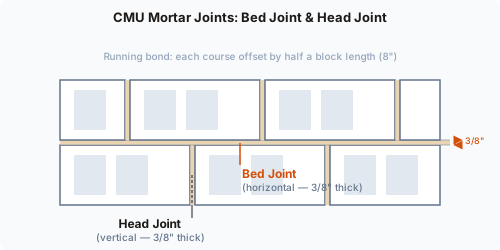
More mortar joints mean more potential water paths. A standard 8-foot basement wall in 8" CMU has 12 courses, each with a continuous mortar joint. Each joint is a potential infiltration point if the waterproofing is breached. Poured concrete has no joints except at the footing.
Requires proper waterproofing, every time. Many older CMU foundations were built with only dampproofing (bituminous coating), not true waterproofing. Over time, dampproofing degrades and water finds the joints. A true waterproofed system with drainage board and a footing drain is the current best practice.
Not recommended in high-seismic zones without special reinforcing. The IRC's seismic design category maps show areas where fully grouted, heavily reinforced CMU is required or where poured concrete is preferred by local practice. If you're in Seismic Design Category D or higher, get local engineering guidance on foundation type before you decide.
More labor-intensive than poured. Setting 1,300 blocks takes more craft time than placing concrete in a form. In tight labor markets, that's a scheduling and cost issue.
IRC Requirements for Residential CMU Foundations
The International Residential Code (IRC) Section R404 covers concrete and masonry foundation walls. Key requirements:
Minimum wall thickness:
- 8-inch CMU for most residential applications up to 7-foot unbalanced backfill
- 10-inch or 12-inch CMU for higher backfill or taller walls
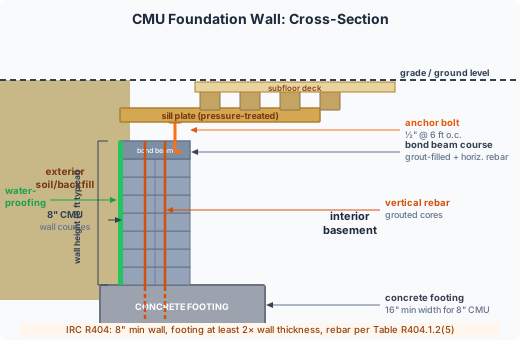
Footing size: Minimum footing width is typically twice the wall thickness. An 8-inch CMU wall needs a 16-inch wide footing minimum. Depth varies by frost depth for your region.
Rebar: IRC Table R404.1.2(5) specifies vertical and horizontal rebar requirements based on wall height, backfill depth, and soil conditions. For a standard 8-foot wall with 7 feet of backfill, #4 rebar at 48 inches o.c. vertical is a common prescription, but always verify against your jurisdiction's adopted IRC version and any local amendments.
Anchor bolts: Sill plates must be secured with 1/2-inch anchor bolts at 6 feet o.c. maximum, within 12 inches of each plate end. These are embedded in the top course of block (usually a bond beam block filled with grout).
Drainage: IRC R405 requires either a drainage layer (6-inch minimum gravel) against the exterior of the wall or a prefabricated drain panel, leading to a footing drain that exits to daylight or a sump.
Common Problems in CMU Foundations
Efflorescence
White mineral deposits on the wall face are caused by water moving through the block and mortar, carrying dissolved calcium carbonate to the surface. It looks bad but usually isn't structurally significant on its own. The fix is to address the water source, not just to clean the surface.
Horizontal Cracking
A horizontal crack in a CMU foundation wall, especially in the middle third of the wall height, is a red flag. This typically indicates lateral soil pressure overloading the wall. It can progress to wall bowing and in severe cases structural failure. If you see a horizontal crack more than 1/8 inch wide, or any wall bowing, get a structural engineer on site before anything else.
Stair-Step Cracking
Cracking that follows the mortar joints in a diagonal stair-step pattern usually indicates differential settlement, one part of the foundation moving relative to another. Minor stair-step cracks at corners are common and often not serious. Wider cracks or cracks that are actively growing need professional evaluation.
Wall Bulging
Any visible bulge or bow in a block foundation wall means the wall is under lateral pressure it wasn't designed to handle, or that it's lost structural integrity. This is a life-safety issue, don't use the basement for storage near that wall until it's been evaluated. Repair options include carbon fiber strapping, steel channel reinforcing, or in extreme cases, wall replacement.
Maintenance Tips for Existing CMU Foundations
Inspect every spring after freeze-thaw season. Walk the perimeter inside and outside, looking for new cracks, increased gap width on existing cracks, and any evidence of water infiltration (mineral staining, efflorescence, or damp spots).
Keep water away from the foundation. Grade the soil around the house to slope away at 6 inches per 10 feet. Make sure gutters are functional and downspouts are discharging well away from the foundation.
Don't paint the interior of a wet block wall. Waterproofing paint applied to the interior of an actively wet foundation wall is a temporary fix that often makes things worse. The hydrostatic pressure behind the wall will push the paint off. Fix the exterior drainage problem first.
Repoint deteriorating mortar joints. Mortar joints that are crumbly, recessed, or cracked should be tuck-pointed, old mortar removed to a depth of 3/4 inch and fresh type S mortar applied. This is straightforward maintenance that prevents water infiltration.
Is a CMU Foundation Right for Your Project?
For most residential applications in low-seismic areas with competent local masonry labor, CMU foundations are a proven, cost-effective choice. They're particularly practical when you want block-level repairability over the building's life, when formwork costs are high in your area, or when a good masonry crew is more available than a concrete forming crew.
They're not the right call for high-seismic zones without engineering, for very deep basements with high backfill pressure, or in areas where masonry labor is scarce and poured concrete is the regional norm.
Before you price out materials, get your block count right. Use the CMU wall estimating tool with your foundation dimensions to establish your material base. Then price mortar, rebar, and grout fill on top of that, those are the line items that vary most by project complexity and code requirements.
For a side-by-side comparison of CMU and poured concrete across all the key factors, see CMU vs. poured concrete. And if you're working through a cost estimate, the concrete block cost guide has current pricing by region and block type.
Ready to estimate your project?
Use our free calculator to get an accurate block count in 30 seconds.
Open CalculatorConcrete Block Calculator Team
The Concrete Block Calculator team builds free, accurate masonry estimating tools based on NCMA TEK Notes and industry-standard coursing arithmetic. Our content is verified against NCMA, ACI, and MCAA publications.
About us