CMU Block vs Poured Concrete Walls: Which Is Better?
CMU block and poured concrete both have a place in construction, but they're not interchangeable. Here's how to choose the right system for your wall type, budget, and site conditions.
Quick Answer: CMU block is typically 15–25% cheaper installed than poured concrete for below-grade walls, and it's easier to build in stages without forms. Poured concrete handles moisture better without additional waterproofing. For most residential projects, either system works; the choice comes down to local labor availability and site conditions.
CMU Block vs Poured Concrete Walls
The choice between CMU block vs poured concrete comes up on nearly every wall project, from residential foundations to commercial retaining walls. Both systems use portland cement as their base, but they behave differently under load, in wet conditions, and on the job site. Picking the wrong one doesn't just cost money; it can mean structural problems that are expensive to fix after the fact.
This breakdown covers the real differences: cost, construction speed, structural performance, moisture behavior, and the specific conditions where each system has an edge.
The Basic Difference
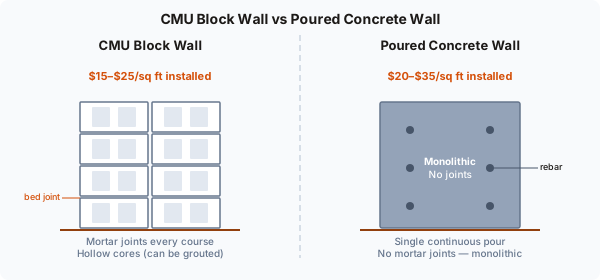
A CMU (concrete masonry unit) wall is built block by block, with mortar filling the joints. The cores can be left hollow, partially grouted, or fully grouted depending on the structural requirement. Rebar is placed in the cores before grouting to add tensile strength.
A poured (cast-in-place) concrete wall starts with temporary formwork, typically plywood or steel forms, that's erected, filled with concrete, and stripped after the concrete cures. The wall is monolithic, meaning it's a single continuous pour with no mortar joints.
That monolithic nature is poured concrete's biggest structural advantage. It's also what makes it less flexible to build with on unusual sites.
Cost Comparison
Installed costs vary by region, but here are representative 2026 figures for a standard 8-inch-thick wall:
CMU block wall (8" CMU, standard running bond):
- Material only: $4.50–$7.00/sq ft (block + mortar + rebar)
- Installed (labor + material): $15–$25/sq ft
- High-spec (fully grouted, engineered): $22–$35/sq ft
Poured concrete wall (8" thick, standard residential spec):
- Material only: $6.00–$10.00/sq ft (concrete + rebar + form rental)
- Installed (labor + material): $20–$35/sq ft
- High-spec (waterproofed, engineered): $30–$50/sq ft
Poured concrete is typically 15–30% more expensive than comparable CMU on small to medium residential projects. The cost difference narrows on very large pours where the economies of a single concrete truck load improve.
For walls over 1,000 sq ft, the comparison shifts, large poured placements can become more cost-efficient than the labor required to lay an equivalent CMU wall course by course.
Construction Speed
CMU is faster to start. You can begin laying block the day after the footing is poured (or sooner, if the footing is old). There's no form-building, no wait for a concrete truck, and no multi-day cure period before the next trade can come in. A skilled two-person masonry crew can lay 200–300 standard blocks per day under good conditions.
Poured concrete requires form construction first, which can take as long as the pour itself on a complex wall. After the pour, forms typically stay in place for 24–72 hours (longer in cold weather) before stripping. You also need to schedule a concrete truck, which introduces lead time and weather dependency.
For a 40 ft × 8 ft wall:
- CMU: A two-person crew can complete this in 2–3 days (layout, leads, fill courses, finishing)
- Poured: Form build takes 1 day, pour is a few hours, strip and finish takes another day, similar total time, but less flexible scheduling
Structural Performance
This is where the comparison gets nuanced.
Poured concrete is monolithic, which means no mortar joints to crack or fail. Under lateral loads, soil pressure, wind, seismic forces, a properly reinforced poured wall behaves as a single structural unit. That's why most structural engineers specify poured concrete for basement foundations in high-load scenarios.
CMU performs well when the cores are properly grouted and reinforced. A fully grouted, rebar-filled 8" CMU wall has compressive strength in the 1,500–3,000 psi range depending on block type and grout. The mortar joints are the weak link, they can crack under differential settlement or poor workmanship, and water infiltrates joints more readily than solid concrete.
That said, CMU handles point loads well because you can place rebar exactly where the load will fall. And for above-grade walls where cracking is a cosmetic rather than structural issue, CMU performs fine.
When Structural Engineers Specify Poured Concrete
- Basement foundations in flood-prone or high water table areas
- Any wall where hydrostatic pressure is a primary design load
- Walls in high seismic zones (Zone 3 or 4) without full CMU grouting
- Walls over 12 feet tall with significant surcharge loads
Moisture and Water Resistance
This is poured concrete's clearest advantage. A properly placed monolithic pour with no cold joints has no inherent penetration points. Add waterproofing membrane and drainage board, and you have a solid moisture barrier.
CMU walls have two moisture vulnerabilities: the mortar joints themselves and the hollow cores. Water wicks through mortar joints over time, especially where joint finishing was rushed or the mortar mixed too dry. Unfilled cores act as channels once water gets past the face.
For below-grade CMU walls, full core grouting is not optional, it's the minimum for any wall in contact with soil. You'll also need an elastomeric parging coat or dimple mat drainage board on the exterior face.
Both systems require proper drainage at the footing. A wall without a working drain system will eventually show moisture problems regardless of which system you chose.
Insulation
CMU's hollow cores are an advantage here. Empty 8" CMU cores can be filled with foam insulation, either poured-in foam beads or spray foam, to bring the wall's effective R-value from around R-1.5 (unfilled) to R-8 to R-12. That's not enough for a modern energy code, but it's a head start before you add furring, rigid insulation, or drywall assemblies.
Poured concrete walls are solid with no built-in cavities. Their R-value per inch is roughly R-0.08, essentially zero thermal resistance. Any insulation has to come from added assemblies on the interior or exterior.
For above-grade applications where wall insulation matters, conditioned basements, garage walls, commercial buildings: CMU with foam-filled cores can be a more cost-effective starting point.
Where Each System Wins
| Factor | CMU Block | Poured Concrete |
|---|---|---|
| Material cost | Lower | Higher |
| Labor flexibility | Schedule block delivery, start anytime | Requires truck and forms on same day |
| Structural integrity (monolithic) | Good when grouted | Better, no joints |
| Moisture resistance | Fair (needs treatment) | Better (no joints) |
| Below-grade foundation | Acceptable with full grout | Preferred by most engineers |
| Garden/landscape walls | Excellent | Rarely used |
| Commercial above-grade | Common choice | Less common |
| Insulation potential | Better (core fill) | Worse (solid, low R-value) |
| Repair/modification | Easy, cut and patch | Difficult, must core drill or form and pour patches |
Which One Should You Choose?
Use CMU when:
- You're building above-grade walls (garden walls, privacy walls, screen walls)
- You need scheduling flexibility, no concrete truck required
- You want the option to insulate cores
- Your project is smaller than 800–1,000 sq ft (where form costs make poured more competitive)
- You're doing the work yourself, block laying is more accessible than form building
Use poured concrete when:
- You're building a basement foundation where water pressure is a primary concern
- The wall is in a high seismic zone and must meet monolithic reinforcement requirements
- Your engineer specifies it
- You're building over 1,000 sq ft of wall where the cost math shifts
For residential above-grade walls and most light commercial applications, CMU is the practical and cost-effective default. For basement foundations and high-load underground walls, poured concrete is usually the better call, and your engineer will likely require it.
Plan Your CMU Material First
If CMU is the right system for your project, start with a solid block count before you call the supplier. Enter your wall dimensions in the concrete block estimating tool to get a precise count with waste factor included.
Then check the CMU dimensions guide to make sure you're specifying the right block size for your wall thickness and load requirements.
For a full cost estimate, the concrete block cost guide has current pricing by block type and region.
Ready to estimate your project?
Use our free calculator to get an accurate block count in 30 seconds.
Open CalculatorConcrete Block Calculator Team
The Concrete Block Calculator team builds free, accurate masonry estimating tools based on NCMA TEK Notes and industry-standard coursing arithmetic. Our content is verified against NCMA, ACI, and MCAA publications.
About us